Lorentz transformation without the speed of light
Lorentz transformation, special relativity, inertial frames
Introduction
Einstein’s 1905 paper takes the invariance of the speed of light as a postulate and derives the Lorentz transformation from it [1]. The usual textbook argument is a short version of that derivation. It is how the Lorentz transformation is typically derived in textbooks. Let’s review that first.
The standard derivation
Let \(S'\) move at constant velocity \(v\) along the \(x\) axis of \(S\), with the origins coinciding at \(t=t'=0\), as in Figure 1.
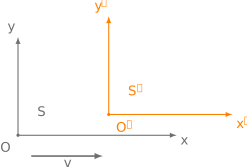
The transformation is linear and homogeneous.
Because the origins coincide at \(t=t'=0\), a linear homogeneous map between the frames has the form \[\begin{equation} x' = Ax + Bt, \label{eq:standard-linear} \end{equation}\] where the coefficients \(A\) and \(B\) may depend on \(v\) but not on \(x\) or \(t\). The origin of \(S'\) follows the trajectory \(x=vt\) in \(S\), and on that worldline \(x'=0\). Substituting into Eq. \(\eqref{eq:standard-linear}\) gives \(0 = A(vt)+Bt\), so \(B=-Av\) and therefore \[\begin{equation} x' = A(x - vt). \label{eq:standard-x-A} \end{equation}\] Renaming the unknown coefficient \(A\) to \(\gamma(v)\), we have
\[\begin{equation} x' = \gamma\,(x - vt) \label{eq:standard-x} \end{equation}\]
for some factor \(\gamma\) that can depend on \(v\) but not on \(x\) or \(t\). Thus linearity fixes the spatial law up to one function of \(v\); that function is still free at this stage. The principle of relativity says the inverse boost is the same rule with \(v\) replaced by \(-v\),
\[\begin{equation} x = \gamma\,(x' + vt'). \label{eq:standard-inverse} \end{equation}\]
Eliminate \(x'\) between Eq. \(\eqref{eq:standard-x}\) and Eq. \(\eqref{eq:standard-inverse}\):
\[\begin{equation} t' = \gamma t + \frac{1-\gamma^2}{\gamma v}\,x. \label{eq:standard-t-general} \end{equation}\]
A light ray emitted at the common origin satisfies \(x=ct\) in \(S\).
The speed of light is the same in every inertial frame.
The second postulate says the same ray satisfies \(x'=ct'\) in \(S'\), so
\[\begin{equation} t' = \gamma\left(1 - \frac{v}{c}\right)t. \label{eq:standard-light} \end{equation}\]
Set \(x=ct\) in Eq. \(\eqref{eq:standard-t-general}\), equate the two expressions for \(t'\), and cancel \(t\). The result is
\[\begin{equation} \gamma = \frac{1}{\sqrt{1 - v^2/c^2}}. \label{eq:standard-gamma} \end{equation}\]
Substituting Eq. \(\eqref{eq:standard-gamma}\) back into Eq. \(\eqref{eq:standard-t-general}\) produces the time transformation
\[\begin{equation} t' = \gamma\left(t - \frac{v}{c^2}\,x\right). \label{eq:standard-t} \end{equation}\]
Eqs. \(\eqref{eq:standard-x}\) and Eq. \(\eqref{eq:standard-t}\) are the Lorentz transformation. The speed \(c\) entered as a postulate about light. That is the step we are about to refuse.
Without the light postulate
The rest of this post derives the same transformation without ever saying that light (or anything else) has a preferred speed. The ingredients are inertia, the principle of relativity, and the requirement that boosts form a group [2]–[4]. Those assumptions already fix the map up to one constant with the dimensions of velocity squared. Light is used only afterwards, if at all, to measure that constant.
What changes relative to the standard derivation is the order of the logic. There we assumed \(x'=ct'\) for a light ray in order to pin down \(\gamma\). Here we first constrain the most general linear map between inertial frames, then use reciprocity and group composition to leave a single free constant \(a=\pm c^2\), and only at the end decide the sign of \(a\) by demanding that time order at a fixed place is preserved. Nothing in that chain names light.
Setup and assumptions
Let \(S\) and \(S'\) be inertial frames. \(S'\) moves at constant velocity \(v\) along the common \(x\) axis of \(S\). The origins coincide when both clocks read zero, so the event \((x,t)=(0,0)\) is also \((x',t')=(0,0)\).
An event is a pair \((x,t)\). The only question we ask is how a measurement in \(S\) determines the measurement in \(S'\):
\[\begin{equation} x' = x'(x,t), \qquad t' = t'(x,t). \label{eq:map} \end{equation}\]
Five assumptions close this problem.
- The map depends only on \(x\), \(t\), and the relative velocity \(v\).
- The laws of physics are the same in every inertial frame.
- A free particle moves at constant velocity on a straight line.
- The composition of two such maps is again a map of the same kind.
- If two events occur at the same place and \(t_2>t_1\), every allowed map preserves that order: \(t_2'>t_1'\).
Inertia forces a linear map
The map Eq. \(\eqref{eq:map}\) is a function of two independent coordinates, so its differentials are \[\begin{equation} \begin{aligned} dx' &= \partial_x x'\,dx + \partial_t x'\,dt, \\ dt' &= \partial_x t'\,dx + \partial_t t'\,dt. \end{aligned} \label{eq:differentials-map} \end{equation}\] Inertia says a free particle that has constant velocity in \(S\) must also have constant velocity in \(S'\). Homogeneity (assumption 1) says the rule relating those velocities cannot depend on the event \((x,t)\). Together they force the four partials in Eq. \(\eqref{eq:differentials-map}\) to be independent of \((x,t)\): \[\begin{equation} \partial_x x' = A,\quad \partial_t x' = B,\quad \partial_x t' = C,\quad \partial_t t' = D. \label{eq:partials-const} \end{equation}\] Integrate Eq. \(\eqref{eq:partials-const}\). From \(\partial_x x'=A\) one has \(x'=Ax+f(t)\); then \(\partial_t x'=B\) gives \(f'(t)=B\), so \(f(t)=Bt+K\). The coincidence of origins, \(x'(0,0)=0\), sets \(K=0\). The same steps for \(t'\) yield
\[\begin{equation} x' = Ax + Bt, \qquad t' = Cx + Dt. \label{eq:linear} \end{equation}\]
In matrix form,
\[\begin{equation} \begin{pmatrix} x' \\ t' \end{pmatrix} = \begin{pmatrix} A & B \\ C & D \end{pmatrix} \begin{pmatrix} x \\ t \end{pmatrix}. \label{eq:matrix} \end{equation}\]
The inverse map is the inverse matrix. With \(\Delta = AD-BC\),
\[\begin{equation} \begin{pmatrix} x \\ t \end{pmatrix} = \frac{1}{\Delta} \begin{pmatrix} D & -B \\ -C & A \end{pmatrix} \begin{pmatrix} x' \\ t' \end{pmatrix}. \label{eq:inverse} \end{equation}\]
The transformation matrix in Eq. \(\eqref{eq:matrix}\) seems to have too many free parameters, but we will impose various physical principles to constrain it. We can also see that \(B\) and \(D\) terms multiply \(t\), and a requirement of time reversal implies \(B\to -B\) and \(D\to -D\) when \(t\to -t\).
Let’s first try to relate \(A\) and \(B\) by matching the origins. The origin of \(S'\) is the trajectory \(x=vt\) in \(S\), and it is \(x'=0\) in \(S'\). Substitute into Eq. \(\eqref{eq:linear}\):
\[\begin{equation} 0 = Avt + Bt \implies B = -Av. \label{eq:B} \end{equation}\]
Then relate \(B\) to \(D\) using the same comparison the other way. In \(S'\), the origin of \(S\) moves at \(-v\), so \(x'=-vt'\) when \(x=0\). The first row of Eq. \(\eqref{eq:inverse}\) then says
\[\begin{equation} 0 = \frac{1}{\Delta}\bigl(Dx' - Bt'\bigr) = \frac{1}{\Delta}\bigl(-Dvt' - Bt'\bigr), \label{eq:reciprocity} \end{equation}\]
hence \(D=-B/v\). Combined with Eq. \(\eqref{eq:B}\),
\[\begin{equation} D = A. \label{eq:D} \end{equation}\]
The two diagonal entries are the same coefficient.
Now let \(S\) time a duration \(T\) at its own origin, \(x=0\). Then \(t'=AT\). The reciprocal experiment, a duration \(T\) at \(x'=0\), is seen from \(S\) as \(t=AT/\Delta\). The principle of relativity requires the two results to agree, so
\[\begin{equation} AT = \frac{AT}{\Delta} \implies \Delta = 1, \label{eq:det} \end{equation}\]
provided \(A\neq 0\). The inverse is therefore
\[\begin{equation} \begin{pmatrix} x \\ t \end{pmatrix} = \begin{pmatrix} A & Av \\ -C & A \end{pmatrix} \begin{pmatrix} x' \\ t' \end{pmatrix}. \label{eq:inverse-simple} \end{equation}\]
Factor \(A\) out of Eq. \(\eqref{eq:linear}\) and rename it \(\gamma\). The ratio \(C/A\) is another constant; call it \(F\). The map is
\[\begin{equation} x' = \gamma\,(x - vt), \qquad t' = \gamma\,(t + Fx). \label{eq:gamma-F} \end{equation}\]
In matrix form,
\[\begin{equation} \begin{pmatrix} x' \\ t' \end{pmatrix} = \gamma \begin{pmatrix} 1 & -v \\ F & 1 \end{pmatrix} \begin{pmatrix} x \\ t \end{pmatrix}. \label{eq:gamma-F-matrix} \end{equation}\]
Neither \(\gamma\) nor \(F\) is known yet: both may still depend on the relative velocity \(v\). Reciprocity has fixed only the shape of the matrix. The next two subsections pin them down.
Boosts form a group
A third frame \(S''\) moves at velocity \(v_2'\) relative to \(S'\), while \(S'\) moves at \(v_1\) relative to \(S\). Write each leg in the matrix form Eq. \(\eqref{eq:gamma-F-matrix}\): \[\begin{equation} \begin{pmatrix} x' \\ t' \end{pmatrix} = \gamma_1 \begin{pmatrix} 1 & -v_1 \\ F_1 & 1 \end{pmatrix} \begin{pmatrix} x \\ t \end{pmatrix}, \label{eq:boost-1} \end{equation}\] \[\begin{equation} \begin{pmatrix} x'' \\ t'' \end{pmatrix} = \gamma_2' \begin{pmatrix} 1 & -v_2' \\ F_2' & 1 \end{pmatrix} \begin{pmatrix} x' \\ t' \end{pmatrix}. \label{eq:boost-2} \end{equation}\] The composite map \(S\to S''\) is the product of the two matrices, \[\begin{equation} \begin{pmatrix} x'' \\ t'' \end{pmatrix} = \gamma_2'\gamma_1 \begin{pmatrix} 1 & -v_2' \\ F_2' & 1 \end{pmatrix} \begin{pmatrix} 1 & -v_1 \\ F_1 & 1 \end{pmatrix} \begin{pmatrix} x \\ t \end{pmatrix}. \label{eq:boost-product} \end{equation}\] Multiplying the \(2\times 2\) factors gives \[\begin{equation} \begin{pmatrix} 1 & -v_2' \\ F_2' & 1 \end{pmatrix} \begin{pmatrix} 1 & -v_1 \\ F_1 & 1 \end{pmatrix} = \begin{pmatrix} 1 - F_1 v_2' & -(v_1 + v_2') \\ F_1 + F_2' & 1 - F_2' v_1 \end{pmatrix}. \label{eq:boost-product-explicit} \end{equation}\] Assumption 4 says this composite must again be a boost of the same kind, up to a common factor:
- equal diagonal entries;
- off-diagonal entries of the pattern \((-v_{\mathrm{tot}},\,F_{\mathrm{tot}})\).
It will be enough to require the first condition, and the second will follow.
Equal diagonals require \[\begin{equation} 1 - F_1 v_2' = 1 - F_2' v_1, \label{eq:diagonals} \end{equation}\] or \[\begin{equation} \frac{v_1}{F_1} = \frac{v_2'}{F_2'}. \label{eq:ratio} \end{equation}\]
The two velocities are independent. The only way Eq. \(\eqref{eq:ratio}\) can hold for every choice is if both sides equal one and the same constant \(a\), independent of which boost we picked. Therefore every boost obeys
\[\begin{equation} F = \frac{v}{a}. \label{eq:F} \end{equation}\]
The transformation is now
\[\begin{equation} x' = \gamma\,(x - vt), \qquad t' = \gamma\left(t + \frac{v}{a}\,x\right). \label{eq:with-a} \end{equation}\]
The determinant condition \(\Delta=1\) fixes \(\gamma\). From Eq. \(\eqref{eq:linear}\) and Eq. \(\eqref{eq:with-a}\),
\[\begin{equation} \gamma^2\left(1 + \frac{v^2}{a}\right) = 1, \label{eq:gamma-det} \end{equation}\]
so
\[\begin{equation} \gamma = \frac{1}{\sqrt{1 + v^2/a}}, \label{eq:gamma} \end{equation}\]
taking the positive root so that \(\gamma\to 1\) as \(v\to 0\).
With \(F=v/a\), the product matrix Eq. \(\eqref{eq:boost-product-explicit}\) becomes \[\begin{equation} \begin{pmatrix} 1 - v_1 v_2'/a & -(v_1 + v_2') \\ (v_1 + v_2')/a & 1 - v_1 v_2'/a \end{pmatrix} = \left(1 - \frac{v_1 v_2'}{a}\right) \begin{pmatrix} 1 & -v_{\mathrm{tot}} \\ v_{\mathrm{tot}}/a & 1 \end{pmatrix}, \label{eq:offdiag-check} \end{equation}\] where \[\begin{equation} v_{\mathrm{tot}} = \frac{v_1 + v_2'}{1 - v_1 v_2'/a}. \label{eq:v-tot} \end{equation}\] The off-diagonals are \((-v_{\mathrm{tot}},\,v_{\mathrm{tot}}/a)\), which is exactly the pattern \((-v_{\mathrm{tot}},\,F_{\mathrm{tot}})\) with \(F_{\mathrm{tot}}=v_{\mathrm{tot}}/a\). So once equal diagonals have fixed Eq. \(\eqref{eq:F}\), the second bullet is automatic. The overall factor \(\gamma_2'\gamma_1\bigl(1-v_1 v_2'/a\bigr)\) is the composite \(\gamma(v_{\mathrm{tot}})\) from Eq. \(\eqref{eq:gamma}\). This leaves behind only one free parameter, \(a\).
The sign of the invariant \(a\)
The constant \(a\) has dimensions of velocity squared. Write \(a=\pm c^2\) and reject the cases that do not work.
\(a=0\) makes Eq. \(\eqref{eq:F}\) undefined for any \(v\neq 0\).
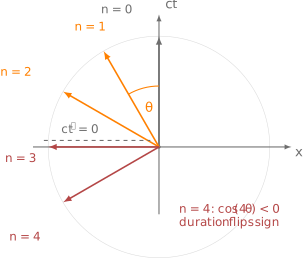
If \(a=+c^2\), set \(v=c\tan\theta\) with \(|\theta|<\pi/2\). Then Eq. \(\eqref{eq:gamma}\) becomes \(\gamma=\cos\theta\), and Eq. \(\eqref{eq:with-a}\) is the Euclidean rotation \[\begin{equation} \begin{pmatrix} x' \\ ct' \end{pmatrix} = \begin{pmatrix} \cos\theta & -\sin\theta \\ \sin\theta & \cos\theta \end{pmatrix} \begin{pmatrix} x \\ ct \end{pmatrix} \label{eq:euclidean-rotation} \end{equation}\] in the \((x,ct)\) plane. Take \(\theta=30^\circ\), so \(v=c/\sqrt{3}<c\) and \(\gamma=\sqrt{3}/2\). Each boost is \[\begin{equation} R = \begin{pmatrix} \tfrac{\sqrt{3}}{2} & -\tfrac12 \\ \tfrac12 & \tfrac{\sqrt{3}}{2} \end{pmatrix}. \label{eq:R30} \end{equation}\] Angles add under composition, so \(n\) such boosts give a rotation by \(n\theta\). After three, \[\begin{equation} R^{3} = \begin{pmatrix} \cos 90^\circ & -\sin 90^\circ \\ \sin 90^\circ & \cos 90^\circ \end{pmatrix} = \begin{pmatrix} 0 & -1 \\ 1 & 0 \end{pmatrix}, \label{eq:R30-cubed} \end{equation}\] and a positive duration at \(x=0\) is mapped to zero duration. After four, \[\begin{equation} R^{4} = \begin{pmatrix} \cos 120^\circ & -\sin 120^\circ \\ \sin 120^\circ & \cos 120^\circ \end{pmatrix} = \begin{pmatrix} -\tfrac12 & -\tfrac{\sqrt{3}}{2} \\ \tfrac{\sqrt{3}}{2} & -\tfrac12 \end{pmatrix}, \label{eq:R30-fourth} \end{equation}\] and at \(x=0\) \[\begin{equation} ct^{(4)} = -\tfrac12\,ct < 0 \label{eq:duration-flip} \end{equation}\] for any \(ct>0\), as in Figure 2. A future interval is sent to a past interval, which contradicts assumption 5. Positive \(a\) is not allowed.
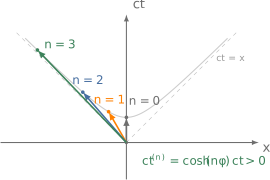
The remaining case is \(a=-c^2\). Set \(v=c\tanh\phi\) with \(\phi\in\mathbb{R}\). Then Eq. \(\eqref{eq:gamma}\) becomes \(\gamma=\cosh\phi\), and Eq. \(\eqref{eq:with-a}\) is the hyperbolic rotation \[\begin{equation} \begin{pmatrix} x' \\ ct' \end{pmatrix} = \begin{pmatrix} \cosh\phi & -\sinh\phi \\ -\sinh\phi & \cosh\phi \end{pmatrix} \begin{pmatrix} x \\ ct \end{pmatrix} \label{eq:hyperbolic-rotation} \end{equation}\] in the \((x,ct)\) plane. Take the same speed as before, \(v=c/\sqrt{3}<c\), so \(\tanh\phi=1/\sqrt{3}\) and \[\begin{equation} H = \begin{pmatrix} \sqrt{\tfrac{3}{2}} & -\tfrac{1}{\sqrt{2}} \\ -\tfrac{1}{\sqrt{2}} & \sqrt{\tfrac{3}{2}} \end{pmatrix}. \label{eq:H-phi} \end{equation}\] Rapidities add under composition, so \(n\) such boosts give a hyperbolic rotation by \(n\phi\). The diagonal entry is always \(\cosh(n\phi)\ge 1\): at fixed \(x=0\), \[\begin{equation} ct^{(n)} = \cosh(n\phi)\,ct \label{eq:duration-stays} \end{equation}\] never changes sign, no matter how large \(n\) is. The image of the positive-\(ct\) axis slides along the unit hyperbola \((ct)^2-x^2=1\) toward the light line \(ct=\pm x\), but never crosses it; see Figure 3. That hyperbola is the level set of the Minkowski interval \[\begin{equation} (ct)^2 - x^2, \label{eq:minkowski} \end{equation}\] which Eq. \(\eqref{eq:hyperbolic-rotation}\) preserves. Spacetime with this invariant is Minkowski space.
Writing Eq. \(\eqref{eq:hyperbolic-rotation}\) back in terms of \(v\) and \(\gamma\) recovers \[\begin{equation} \gamma = \frac{1}{\sqrt{1 - v^2/c^2}}, \label{eq:lorentz-factor} \end{equation}\] and \[\begin{equation} \begin{aligned} x' &= \gamma\,(x - vt), \\ t' &= \gamma\left(t - \frac{v}{c^2}\,x\right). \end{aligned} \label{eq:lorentz} \end{equation}\] Eq. \(\eqref{eq:lorentz}\) is the Lorentz transformation. Nothing in the derivation said what propagates at speed \(c\). The constant is a property of the map between inertial frames.